 DealNest
 A game of chiaroscuro — a door opening to enchantment and fantasy, built from tonka bean, frankincense and black tea.
L’Ombre des Merveilles, released in 2020, is one of the darker entries in the Merveilles sub-collection — an eau de parfum built around three ingredients (tonka bean, frankincense and black tea) and presented in a starred, pebble-shaped bottle that sits askew, deliberately unstable, on the dresser. It is a quieter, more contemplative fragrance than its siblings in the Merveilles family, and it extends the sub-collection into incense-oriental territory that none of the earlier entries had explored. This is a long review of what Ombre is, how it sits alongside the other Merveilles fragrances, and who it suits.
A darker corner of the Merveilles idea
The Merveilles family began in 2004 with Eau des Merveilles, a woody-amber women’s fragrance built without floral notes and anchored by ambergris. Over the next decade and a half, Hermès extended the idea in successive directions: L’Ambre des Merveilles (2012) leaned into the ambered warmth; Eau des Merveilles Bleue cooled it into maritime air; Elixir des Merveilles pushed it toward a warmer gourmand-oriental register.
L’Ombre des Merveilles occupies a different corner of the same room. Rather than amber-warm or marine-cool, Ombre is incense-shadowed — a chiaroscuro composition, to borrow the house’s own framing, that holds light and dark in the same frame. It is the most meditative member of the family and the one that reads most clearly as an evening fragrance.
The three ingredients
Hermès released L’Ombre des Merveilles with a deliberately compact ingredient story: three raw materials at the centre of the composition, each doing specific work.
Tonka bean provides the fragrance’s roundness and warmth. It is a naturally-occurring material — the seed of the Cumaru tree — that carries hay-like, almond-ish, vanilla-adjacent, softly powdery qualities in perfumery. It is the element in Ombre that keeps the fragrance from feeling austere; it provides the glow in the chiaroscuro.
Frankincense (olibanum) provides the shadow. It is one of the oldest materials in perfumery, with a cool, resinous, slightly lemony-smoky character that has been associated with contemplation and ritual across cultures for millennia. In Ombre, the incense is modern rather than ecclesiastical — lighter, cleaner, more ambient. It gives the fragrance its distinctive spiritual-atmospheric register without tipping over into heavy church-incense territory.
Black tea provides the character. Tea notes in perfumery can range from light and green to warm and smoky; the black tea in Ombre sits in the warmer end of that range, carrying a dry, slightly tannic, slightly leather-edged quality that threads through the heart and base. Black tea is also, usefully, a note that reads unisex — neither floral nor aggressively spiced.
Together these three materials produce a composition that is quietly distinctive. The tonka bean warms the frankincense so it never feels dry; the frankincense cools the tonka bean so it never feels sweet; the black tea gives both of them a middle register to sit in. It is a carefully balanced trio, and the composition does not attempt to do more than the three of them can do together.
Olfactory profile
- Family: Oriental — Incense
- Centre: Tonka bean, Frankincense, Black tea
- Concentration: Eau de parfum
- Perfumer: Christine Nagel
- Year: 2020
- For: Women (wears comfortably unisex)
- Family: Part of the Hermès Merveilles sub-collection
How it wears
L’Ombre des Merveilles opens quietly. Unlike the original Eau des Merveilles, which announces itself with a woody-amber chord, Ombre starts almost hushed — frankincense and tonka arriving together, neither dominating, with the black tea already threading through the composition. There is no citrus burst, no dramatic top. The fragrance begins in its own twilight.
Through the first hour, the three ingredients come into clearer conversation. Frankincense leads in the early heart phase — its cool resinous quality establishing the chiaroscuro atmosphere — and tonka bean’s rounded warmth begins to make itself felt beneath it. Black tea threads the whole composition together, adding a dry, tannic continuity that keeps the fragrance from feeling like a simple incense. This is the phase a wearer recognises as Ombre at its most characteristic: quiet, atmospheric, evening-oriented, gently mysterious.
Through the middle hours, the composition sits closer to the skin and the tonka bean takes more prominence. The fragrance warms and becomes faintly powdery without becoming sweet. The incense does not disappear; it recedes into a soft halo around the tonka-and-tea centre.
The drydown, over several hours, is a quiet blend of all three materials with a musky warmth underneath. Longevity is strong for the Merveilles family — the eau de parfum concentration ensures that Ombre holds on skin for most of an evening, and on fabric into the following day.
Who it’s for
L’Ombre des Merveilles suits wearers who like incense or tonka compositions and who want a fragrance that leans toward contemplation rather than projection. It is a quieter fragrance than most of the Merveilles family, and it rewards wearers who prefer close-range compliments to sillage trails.
It is at its best in autumn, winter, and cool evenings. In heat the composition can lose some of its distinctive balance — tonka bean tends to bloom, and the frankincense can feel lighter than intended. In cool weather and indoor settings, however, Ombre is unusually beautiful.
The fragrance reads comfortably unisex. It is marketed toward the women’s side of the Hermès range, but its three central ingredients — tonka, frankincense, black tea — are all classically unisex materials, and many men wear Ombre without it registering as a women’s fragrance. For wearers of Hermès men’s fragrances like Terre d’Hermès, Ombre is a thoughtful evening companion.
The pebble bottle, reinterpreted
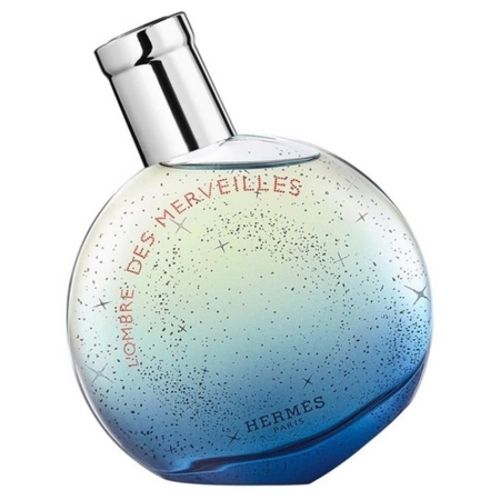
The Ombre des Merveilles bottle takes the pebble form first used for Eau des Merveilles Bleue and dresses it in a different visual register. The body of the bottle is bluish gradient glass, dusted with a constellation of small silver stars; the cap is a chrome spray, the fragrance name appears in orange. Like Bleue, the bottle is deliberately unstable — it rocks slightly on its tumbler base — and the instability is part of the fragrance’s meaning. Nothing about the Merveilles family has ever been about standing still.
The bottle is also notably refillable. Hermès has continued to push refillability across its fragrance range, and the Ombre presentation is one of the cleaner examples of the approach.
Where it sits in the Merveilles family
Reading L’Ombre des Merveilles alongside the rest of the family:
- Eau des Merveilles (2004) — the original; woody-amber, ambergris-centred, citrus at the base.
- L’Ambre des Merveilles (2012) — deeper amber reading of the idea.
- Eau des Merveilles Bleue — the cool maritime reading.
- Elixir des Merveilles — the gourmand-amber flanker.
- L’Ombre des Merveilles (2020) — reviewed here; incense-tonka chiaroscuro.
Within the family, Ombre is the most introverted. Where Elixir is dessert-warm and Bleue is coastal-cool, Ombre is an evening at a writing desk — lamp-light, incense, a cup of tea growing cold. It is the Merveilles fragrance for a slower hour and a quieter mood. A collector who already owns other members of the family will find that Ombre occupies a genuinely different emotional register rather than overlapping with any of them.
Read more broadly against the Hermès catalogue, Ombre is one of the house’s few genuinely incense-forward fragrances. The maison has explored resins in some of its niche and Hermessence pieces, but in the mainstream catalogue incense is rare. For wearers drawn to resinous-oriental compositions, Ombre is worth considering as an entry point into the Merveilles family.
Closing
L’Ombre des Merveilles is the right kind of late flanker — one that extends a sub-collection into territory the original did not cover, rather than diluting the original by repetition. Christine Nagel’s tonka-frankincense-black tea chord is a quiet, meditative composition, and the unstable pebble bottle is a reminder that the Merveilles family has always been about fragrances that live between registers. Ombre is the shadow in the line. It is the Merveilles fragrance for the hours after dusk.