Christine Nagel and Galop d’Hermès: A Perfumer’s Portrait Through Her First Hermès Signature
 DealNest
 Galop d’Hermès was the fragrance that introduced Christine Nagel’s sensibility to the house she was about to lead. A look at her career before Hermès, what her signature reveals, and why Galop matters as an arrival.
When Galop d’Hermès arrived in 2016, it was not just a new Hermès fragrance. It was the first major public gesture of Christine Nagel’s tenure as the house’s in-house perfumer — a role she had stepped into alongside Jean-Claude Ellena and would inherit fully as he retired from the role. Galop is treated as a composition in our main Galop d’Hermès review, and its bottle and ingredients are examined in our companion pieces on the stirrup flask and the saffron-rose-leather composition. This piece focuses on Nagel herself: where she came from, how her sensibility was formed, and why Galop reads as the arrival it is.
Before Hermès
Christine Nagel’s perfumery career before Hermès was substantial. Trained originally in chemistry, she moved into perfumery in the 1980s and progressed through a series of commercial and creative positions at major fragrance houses. Her early work at Quest International, followed by positions at Firmenich and other major houses, established her credentials as a technically rigorous perfumer who could translate commercial briefs into finished compositions without sacrificing creative identity.
Her portfolio before 2014 is notable for its range. Nagel has been credited with contributions to successful fragrances across several luxury and designer houses. Selected highlights from her career include compositions for Narciso Rodriguez, where she worked on the celebrated For Her line; for Cartier, where her work contributed to the house’s fragrance catalogue; and for Lolita Lempicka and other names in the designer-fragrance sector. Her work has frequently been recognised within the industry for its combination of modernity and craft.
That range matters for understanding Nagel’s Hermès work. She did not arrive at the house as a specialist — not exclusively a men’s perfumer, not exclusively a women’s perfumer, not exclusively a commercial perfumer or a niche one. She arrived as a generalist with a proven capacity to work across categories, which is precisely the profile Hermès needed for its women’s, men’s, unisex, and cologne lines.
The move to Hermès
Nagel joined Hermès in 2014 as a co-nose alongside Jean-Claude Ellena, who had been the house’s first in-house perfumer since 2004. The two-year overlap was a deliberate transition plan. Ellena had established the house’s contemporary aesthetic — transparent, architectural, restrained — across a decade of signature compositions, and handing that aesthetic to an incoming perfumer without a handover period would have been abrupt. The 2014–2016 overlap gave Nagel time to work alongside Ellena, absorb the house’s compositional practices, and begin developing her own signatures within the Hermès framework.
Galop d’Hermès was the result of that transition. Composed by Nagel and released in 2016 as Ellena retired from full-time duties, the fragrance was her first major solo signature for the house and the clearest public demonstration of how her sensibility would shape the Hermès catalogue going forward.
What Galop tells us about Nagel’s sensibility
Reading Galop as a Christine Nagel portrait involves noticing what the composition does differently from the Ellena work that preceded it. Several features stand out.
More material-forward. Ellena’s Hermès work tends toward transparent construction — a fragrance feels like an atmosphere more than a collection of ingredients, and identifying specific notes requires effort. Nagel’s Galop is more readable. The rose, the saffron, the leather, the quince — these materials announce themselves, and a wearer can pick them out with relative ease. This is not less sophisticated than Ellena’s approach; it is a different compositional choice, one that trusts the wearer to engage with a fragrance at the ingredient level.
More openly sensual. Ellena’s women’s work (notably Jour d’Hermès) is characterised by restraint — the fragrance rewards closeness rather than projection, and its emotional register is contemplative. Galop is less retiring. The rose-and-leather pairing at its centre has a deliberately physical quality; the fragrance reads as confident rather than quiet.
More willing to engage with oriental registers. Ellena’s Hermès work largely avoided classical oriental perfumery — the amber, spice, resinous territory that dominated luxury women’s fragrance through much of the twentieth century. Nagel’s Galop engages directly with that heritage through saffron, leather and rose, and her later Hermès work has continued to explore oriental-influenced registers that Ellena’s catalogue did not touch.
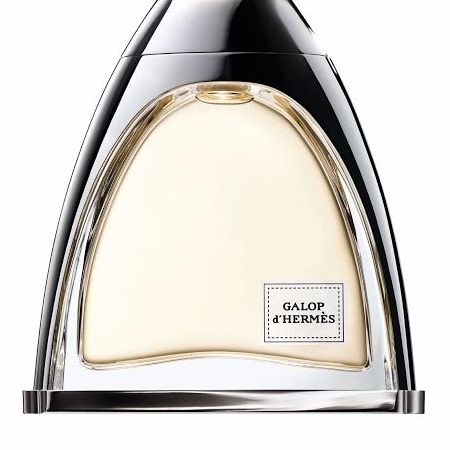
More willing to be decorative. The Galop bottle — a glass stirrup cradled in metal, tied with a leather lace — is more openly ornamental than the flasks of the Ellena era. Both approaches produce beautiful objects, but Nagel’s Hermès launches have tended to have more overt visual identities than the restrained Ellena-era bottles.
Continuity rather than disruption
What is equally important is what Galop does not do. Nagel did not arrive at Hermès with a mandate to reinvent the house, and Galop is not a repudiation of the Ellena aesthetic. The fragrance uses the same restraint in ingredient count that Ellena preferred — four main materials rather than a dense pyramid. It maintains the house’s commitment to high-quality raw materials, expensive ingredients used generously, and composition as craft rather than marketing.
Galop is, in this sense, a continuation of the Hermès tradition under different hands. The architecture is Ellena’s school; the voice is Nagel’s. The combination is precisely what a house in transition needs — not a break with the past but a new chapter written in a recognisable language.
The larger Nagel project at Hermès
Galop was followed by a growing catalogue of Nagel compositions for Hermès. Twilly d’Hermès (2017) was her first major women’s signature after taking over sole in-house responsibility. H24 (2021) was the first new mainstream men’s fragrance from the house in fifteen years. L’Ombre des Merveilles (2020) extended the Merveilles sub-collection into incense-chiaroscuro territory. Eau des Merveilles Bleue brought maritime inflection to the Merveilles family.
Her work across the cologne line has included Eau de Citron Noir (with its smoky Persian black-lemon centre) and Eau de Rhubarbe Écarlate (the sweet-and-tart rhubarb composition). She has also contributed to the Jardins collection and to line extensions of existing fragrances, including Terre d’Hermès Eau Intense Vétiver — the first Terre d’Hermès composition not by Ellena.
Taken together, the post-Galop Nagel catalogue at Hermès demonstrates what her 2016 arrival first suggested: a perfumer comfortable across men’s, women’s, unisex and cologne registers; willing to work with unusual materials (limoo amani, sclarene) as central ingredients; and committed to composition as craft rather than commercial extension.
Reading Galop as arrival
A decade after its 2016 launch, Galop reads differently than it did on release. At the time, it was a single launch — Christine Nagel’s first solo Hermès fragrance, distinctive but also of its moment. With the benefit of the Nagel catalogue since, Galop reads more clearly as a signature statement. Its rose-leather centre, saffron accent, equestrian identity, and confident projection are all now recognisable elements of what the Nagel Hermès aesthetic has become.
Galop is also, in retrospect, a careful fragrance. A new in-house perfumer taking over from a decade-plus predecessor could have overreached, tried to make a bigger statement, or ignored the house’s existing aesthetic. Nagel did none of those. She composed a fragrance that was unmistakably her own while remaining unmistakably Hermès, and the care of that balance is part of what has given the fragrance its staying power.
Closing
Galop d’Hermès is a composition, a bottle, and a business moment. Reviewed strictly as a fragrance, it is a distinctive rose-leather signature in the contemporary Hermès catalogue. Reviewed strictly as a design object, it is a thoughtful piece of stirrup-bottle craft. Reviewed as the arrival of Christine Nagel at the house she was about to lead, it is a quietly confident statement — one that tells you, without shouting, who the new in-house perfumer is and what she intends to do. Nearly a decade later, that statement has been borne out by the catalogue Nagel has built at Hermès, and Galop remains the clearest first chapter of that work.