H24 d’Hermès Advertising Campaign: Jan Gleie, Tim Dibble and the Visual Language of Contemporary Masculinity
 DealNest
 “To create this new signature of Hermès perfumery, I had to open other less predictable paths, to move away from a conventional woody.” — Christine Nagel
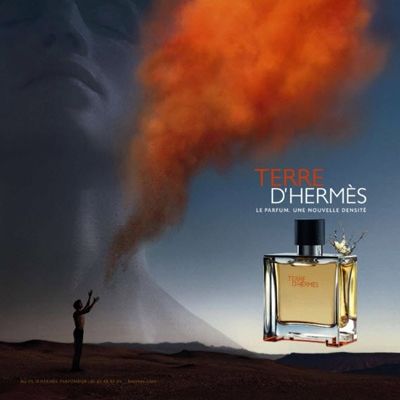
H24, released on 24 February 2021, was the first new masculine fragrance from Hermès in fifteen years — the first major men’s launch from the house since Terre d’Hermès in 2006. The advertising campaign that introduced the fragrance was as carefully constructed as the composition itself: a short film directed by Jan Gleie, featuring model Tim Dibble, photographed by Christopher Anderson, and built entirely around a thesis about contemporary masculinity that the fragrance itself argued through smell. This piece focuses on the campaign and what it tells us about how Hermès positioned H24. The full fragrance review has been covered separately in our main piece on H24 d’Hermès.
A fifteen-year gap, and what it meant
Hermès’s decision not to release a new mainstream men’s fragrance between 2006 and 2021 was unusual. Most luxury houses operate on a much shorter launch cycle, and most men’s lines are extended with flankers and related compositions every few years. Hermès instead allowed Terre d’Hermès to establish and extend its position across fifteen years, with only concentrations and flankers added to the main line rather than a new flagship.
When H24 finally arrived, the fifteen-year pause had given the launch a certain weight. The house could not afford to release an incremental men’s fragrance after that interval; it had to release a composition that genuinely represented a new direction. Christine Nagel — Hermès’s in-house perfumer since she succeeded Jean-Claude Ellena — composed the fragrance explicitly to occupy territory that Terre d’Hermès did not occupy, and the advertising campaign was built to make that positioning visible in a single short film.
The brief: nature and technology
Hermès positioned H24 as the “olfactory expression of contemporary man” — a lively, sensual, luminous fragrance cultivating, in the house’s own phrase, “the daring hybridisation between nature and technology.” The phrase contains the campaign’s thesis. H24 was not a nature fragrance, not a technology fragrance, but something built from the intersection of the two: sage and rosewood (natural elements) alongside the synthetic molecule sclarene (a laboratory-produced material that Nagel described as smelling like steam rising from a hot iron pressing damp fabric).
The man the fragrance was built for, in Hermès’s framing, lives simultaneously in both registers. He walks in nature and works in architecture. He uses technology and cares about craft. His contemporary masculinity is hybrid — not a rejection of the past but a specific configuration of the present. The campaign had to make this visible in a way that smell alone could not.
Jan Gleie and the short film
Jan Gleie, the director Hermès commissioned for the campaign, created a short film that structures H24’s thesis through movement and visual rhythm. The film follows Tim Dibble, the British model cast as the campaign’s central figure, as he moves through a sequence of environments that dissolve into each other. Architectural spaces — contemporary buildings, glass, concrete, steel — give way to natural ones. Forest paths, light through leaves, open landscapes. The transitions are not cuts; the environments bleed into each other in a way that argues, visually, that the distinction between them is less fixed than it looks.
This is the campaign’s central move. Rather than showing a man in nature or a man in architecture, the film shows a man moving through both as a single continuous space. The camera behaviour mirrors this: lines curve, horizons tilt, perspective shifts so that the same frame can read as a building or as a forest depending on how your eye resolves it. H24, in the film’s framing, is a fragrance that “sees beyond the lines” — past the categories that would separate natural and built environments.
Gleie’s visual style keeps the whole film uncluttered. There are no multiple actors, no narrative, no product close-up sequences of the kind that dominate most luxury fragrance advertising. The film is almost meditative, and its running time is short. It does not try to persuade; it tries to establish an atmosphere in which the fragrance’s thesis can be taken in without argument.
Tim Dibble and the casting
Tim Dibble’s presence as the campaign’s central figure was another considered choice. Dibble, a British model with a prominent career in high-fashion editorial and runway work, represented a specific kind of contemporary masculinity — understated, physically graceful, neither openly muscular nor softly androgynous, with a face that reads as serious rather than decorative. His stillness carries the film; he moves through the environments without performing for the camera.
Casting a model rather than a celebrity actor (as many luxury men’s fragrance campaigns do) was consistent with Hermès’s general approach. The house tends to use recognisable-but-not-dominant faces in its advertising, trusting the craft of the product to carry the communication rather than a star’s association. For H24 specifically, using a less narrative-laden face allowed the fragrance’s concept — the nature-technology hybridisation — to do its own editorial work.
Christopher Anderson’s photography
Christopher Anderson, the Magnum photojournalist responsible for the campaign’s still photography, brought another layer of seriousness to the H24 rollout. Anderson’s work has long sat at the intersection of fine-art photography and editorial journalism, and his eye for composition and texture aligned naturally with the fragrance’s brief. The campaign’s still images — some of which were released alongside the short film, others of which appeared in print and digital advertising — share the film’s visual grammar: uncluttered, lit to favour form over ornament, attentive to the relationship between figure and environment.
For a fragrance campaign to engage a photographer of Anderson’s stature was another signal of how Hermès wanted H24 to be read. The campaign was not trying to imitate standard prestige fragrance advertising; it was trying to argue that H24 deserved the same seriousness that the house brings to its other disciplines.
The bottle in the campaign
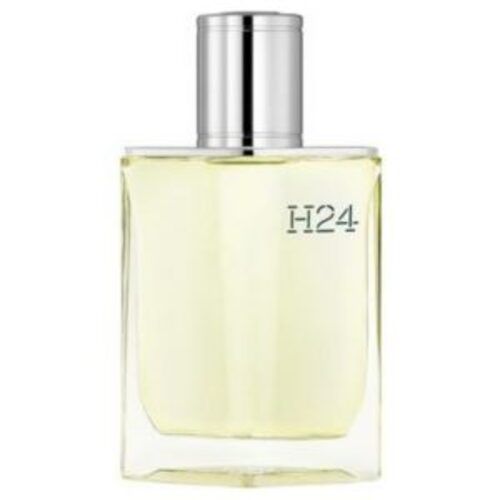
The final protagonist of the H24 campaign, as Hermès itself noted, is the bottle — the rhombus-shaped glass flask made by French glassmaker Pochet du Courval, finished in urban grey with an acid-green cap. The bottle appears late in the film, not as the climax of a revealed product shot but as a quiet object that the viewer encounters after the environments have been established.
The bottle’s form — diamond-shaped, entirely glass, deliberately free of visible decoration — is in dialogue with both the natural and the technological sides of the fragrance’s thesis. It reads as a crystal, as a machined object, and as an abstract form. Like the fragrance, it is not trying to be of any single register.
The campaign’s treatment of the bottle is unusually restrained for a luxury launch. Most fragrance advertising builds toward a close-up reveal of the product; the H24 campaign treats the bottle as an ambient presence, one element in a larger visual argument rather than the argument’s conclusion.
The number 24 in the campaign’s framing
The name H24 works on multiple registers, and the campaign engages each of them without explicitly naming any. The 24 refers simultaneously to the 24 hours of a day (the fragrance is positioned as one a man can wear through his full waking life), to 24 Faubourg Saint-Honoré (the Hermès flagship address, which the house has occupied since 1880), and to the general sense of rhythm and continuity that underpins the fragrance’s thesis. The film engages all three implicitly — its pacing suggests a full day compressed, its visual vocabulary carries Hermès signature codes, and its atmosphere of continuous motion aligns with the 24-hour idea.
The H, as Hermès itself has suggested, carries its own layered meanings: Hermès, Human, Humanity, Hour. The campaign does not explain any of this. It trusts the viewer to do the connecting.
Where the campaign fits in Hermès’s visual history
Hermès’s advertising history is distinct from most luxury houses. The company tends toward restrained, craft-forward imagery that emphasises product or scenario rather than aspirational celebrity. Iconic Hermès silk-scarf campaigns, saddlery imagery, the long-running use of horse-and-carriage motifs — all of this established a visual grammar that the fragrance campaigns have inherited and extended.
H24’s campaign sits within that tradition while pushing it forward. It retains the house’s preference for understatement and its trust in the viewer’s intelligence, but it engages more explicitly with contemporary aesthetic categories — architecture, abstraction, technology — than earlier Hermès campaigns have tended to do. For a house whose identity is sometimes perceived as conservative, the H24 campaign read as a clear generational statement: the maison is willing to speak in the visual language of now without losing what has always made it recognisable.
The fragrance the campaign introduced
The fragrance itself — reviewed in full in our main piece on H24 d’Hermès — carries the advertising campaign’s ideas into smell. Sage, narcissus, and rosewood give the composition its natural register. Sclarene, the synthetic molecule at the centre, supplies the technological one. The result is a fragrance that reads as neither aromatic-fougère (the old masculine default) nor as a contemporary fresh-clean (the 1990s masculine default), but as something new — green and metallic, linear and architectural, built around the hybridisation the campaign made visible.
For wearers and viewers who encountered H24 through the campaign before smelling the fragrance, the film did real persuasive work. The positioning became legible before the wearer ever approached a tester bottle, and the fragrance’s unusual register was easier to accept because the campaign had prepared the ground for it.
Closing
The H24 advertising campaign is one of the more carefully-made fragrance launches of the contemporary luxury market. Jan Gleie’s film, Tim Dibble’s presence, Christopher Anderson’s photography, and Hermès’s restraint in putting the product forward combine to produce a campaign that argues its fragrance’s thesis — the nature-technology hybridisation of contemporary masculinity — without ever stating it explicitly. After a fifteen-year pause in new Hermès men’s releases, H24 arrived with a visual vocabulary that matched the seriousness of the composition inside the bottle. Read together, the campaign and the fragrance make the strongest case Hermès has made for where its men’s line is going in the twenty-first century.