
GoPro Hero5 Black Review: The Action Camera That Made Waterproofing and Touchscreens Standard
 DealNest

GoPro’s 2016 flagship action camera integrated waterproofing and a touch display into a single body for the first time — establishing the template that every subsequent GoPro has built on.
The GoPro Hero5 Black, released in October 2016, is one of the more historically important action cameras ever made. Before the Hero5 Black, serious GoPro use required a separate waterproof housing and a workaround for the missing display on earlier Black models. The Hero5 brought both waterproofing and a touch screen into the camera body itself, dramatically simplifying how the camera was used day-to-day. This long review looks at what the Hero5 Black offered, how it performed, and why it matters in the lineage of action cameras — both the GoPro models that followed and competitors from Garmin, Sony and DJI.
Integrated waterproofing
The single most notable change on the Hero5 Black was that it no longer required a separate waterproof housing. The camera body itself is waterproof to 10 metres (33 feet) — not by virtue of being inside a housing, as earlier Hero Black models were, but by virtue of its own sealed construction. The exterior feels rubbery and tactile, and the camera’s overall form factor closely resembles earlier Hero models while hiding the seals and gaskets that make it genuinely waterproof.
This change alone justifies much of the Hero5 Black’s historical importance. Earlier GoPros required you to buy, carry and maintain a separate housing for any underwater or high-moisture use. The housing added bulk, obscured the display, reduced audio quality, and introduced a point of failure if the housing seal failed. Integrated waterproofing removed all of these issues at once.
The USB-C / HDMI port door is the one concern worth noting in the integrated-waterproofing design. The door pops off for placement into the Karma gimbal accessory and for charging, and it relies on a button-press-and-slide mechanism to prevent accidental opening. In normal use the door is secure, but losing it while travelling is possible, and replacement doors are sold as accessories. Serious owners often carry a spare.
The battery compartment on the underside of the camera holds both the battery and the microSD card, with its own secure latch. Again, the design keeps water out reliably during normal use but relies on the owner being careful to close it properly before any water exposure.
Touch display
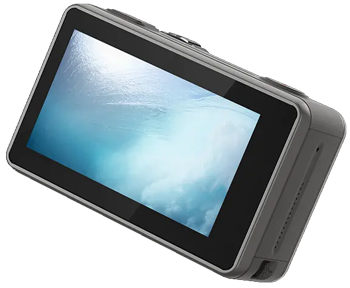
The Hero5 Black includes a 2-inch colour touch display on the rear of the camera — a significant change from the Hero4 Black, which lacked a display entirely. In the Hero4 generation, users who wanted a display typically had to choose the Hero4 Silver (which had a touch display) or use a phone app as a remote viewfinder. The Hero5 Black removed that trade-off by combining the Black-line’s video capabilities with an integrated screen.
The menu system on the Hero5 was redesigned for touch use. The bottom of the display shows the basics for each mode — resolution and frame rate for video, for example — and tapping those values brings up options to change them. Only the valid frame rates for a given resolution are shown, which makes configuration faster than the Hero4’s multi-step menu system.
The touch interface looked beautiful in concept but was not always easy in practice — the small display can make it fiddly to hit specific settings with a normal finger.
Advanced settings (ProTune, Image Stabilization, Audio Control) are accessed via swipes and additional taps on the right side of the display. The full touch experience requires some practice, but most users adapt within a few sessions.
The touchscreen is waterproof, in line with the rest of the body, but it does not work underwater — water on the screen confuses the touch sensing. For underwater use, the physical buttons on the top and side of the camera remain the primary interface. If your fingers are wet when attempting to use the touch display, performance degrades noticeably.
Video capabilities
The Hero5 Black’s core video specifications resemble the Hero4 Black in many ways. Both cameras offer 4K video at 30 frames per second at one end of the spectrum and 720p at 240fps at the other. In between, a full range of resolutions and frame rates is available for various use cases.
The main new video feature on the Hero5 Black is electronic image stabilization (EIS). EIS works by capturing a larger frame than the output resolution requires and using the extra margin to correct for camera movement, trimming the edges to produce smoother footage. The Hero5 Black’s EIS is available up to 2.7K output — not the full 4K — because of the resolution overhead EIS consumes.
EIS is not as good as optical image stabilisation (OIS, used by Sony’s X3000R and some other cameras) because EIS crops the image and OIS does not. But for most action-camera use cases — bike-mounted, helmet-mounted, handheld — EIS provides a meaningful improvement in footage smoothness. If your output is 1080p, enabling EIS while capturing at 2.7K is almost always worthwhile.
ProTune, GoPro’s manual settings mode, includes several useful Hero5 Black features. The ability to record audio from the camera’s multiple microphones as separate tracks (rather than only the mixed stereo output) is particularly valuable for post-production audio work. Three levels of ProTune audio quality are available.
Photo capabilities
The Hero5 Black’s photo capabilities include burst mode, photo timelapses (producing many still image files), and night photo mode for low-light scenarios. Photo timelapse is separate from video timelapse — the first produces a folder of still images, the second produces a compressed video file — and the distinction is important for workflow reasons.
Image resolution is similar to the Hero4 Black, but the Hero5 introduced a number of quality-of-life photo improvements. The touch interface makes photo framing easier; the camera’s better sensor and processing produce cleaner still images in low light; and the integrated waterproofing means underwater photography is possible without additional equipment.
Voice control
The Hero5 Black introduced voice control — the camera recognises spoken commands in seven languages and responds to instructions like “GoPro start recording” or “GoPro take a photo.” In stationary use, voice control works reliably. The combination of voice control with the optional Remo accessory (a small waterproof remote microphone) extends the useful range in noisy environments.
In motion, voice control’s reliability drops. Above roughly 15–16 km/h (10 mph), ambient wind and other noise make voice commands unreliable on most mounts. The exception is when the camera is facing the user — a chest mount, for example, where the user’s voice can reach the microphones relatively unobstructed. Cameras facing forward from a helmet or bike mount tend to lose voice recognition at speed.
Garmin’s VIRB Ultra 30 — a contemporaneous competitor — performed voice control better at speed in comparative tests, though the Hero5 Black still offered the feature as a meaningful addition for non-motion use cases.
Who the Hero5 Black was for
The Hero5 Black was designed for the broad consumer action-camera audience: action sports enthusiasts, travel videographers, adventure-content creators, and anyone who wanted a rugged, waterproof, high-quality video camera they could take where conventional cameras could not go. Its feature set — 4K video, integrated waterproofing, touch display, EIS, voice control — made it the default choice for serious action-camera users when it launched.
Against the Hero5 Session (a more compact, button-only variant released alongside the Black), the Hero5 Black offered the touch display and more complete feature set. The Session was cheaper and smaller but lacked framing flexibility — you had to shoot and hope you had the framing right, or use a phone as a remote viewfinder. For most users, the Hero5 Black was the better buy.
The Hero5 Black in context today
Since the Hero5 Black’s 2016 launch, GoPro has released the Hero6 Black (2017), Hero7 Black (2018, introducing HyperSmooth stabilisation), Hero8 Black (2019, with integrated mounting fingers), Hero9 Black (2020, with front-facing display), Hero10 Black (2021), Hero11 Black (2022), Hero12 Black (2023), and the current Hero13 Black. Each generation has improved on the Hero5 Black’s template — better stabilisation, higher resolutions, longer battery life, additional features — but the integrated-waterproofing + touch-display combination that defined the Hero5 Black has been the template every subsequent model has worked from.
For buyers considering action cameras today, the Hero5 Black is no longer a current product. The used market has plenty of Hero5 Black cameras at low prices, and the camera remains capable for basic action-photography uses. But any serious current purchase should go to a more recent Hero model — the Hero11 Black or later is currently the sensible mainstream choice for new buyers.
The Hero5 Black’s historical significance comes from combining integrated waterproofing and a touch display in a single camera body for the first time — the template that has defined every GoPro since.Closing
The GoPro Hero5 Black was not a perfect camera — voice control had limits, the touch display fought with wet fingers, EIS cropped the image in ways OIS would not — but it was a genuinely important one. By integrating waterproofing into the camera body and reintroducing a touch display to the Black line, it established the template for every GoPro that has followed. For buyers interested in the history of consumer action cameras, the Hero5 Black is the reference point; for buyers looking at current products, GoPro’s more recent Hero models are where the category has evolved to since.




While the Hero7 Black doesn’t offer any more resolution than the Hero4 Black did, it does offer a number of substantial photo-focused features. First, the basics though. To get into the photo mode you’ll go ahead and tap the mode button until you see photos. Or, just tell the GoPro to take a photo using voice commands.