 DealNest
 A candied-orange and vanilla-biscuit reading of the Merveilles idea, anchored by amber, incense and resinous wood.
Elixir des Merveilles, released in 2006, is Jean-Claude Ellena’s gourmand-amber contribution to the Merveilles sub-collection — a fragrance that takes the woody-amber architecture of the 2004 Eau des Merveilles and pushes it into richer, more dessert-adjacent territory. It is the warmest fragrance in the Merveilles family, and it has become, in the years since its release, one of the more consistently-recommended winter fragrances in the broader Hermès women’s range. This is a long review.
Ellena’s reading of the Merveilles idea
The original Eau des Merveilles was composed by Ralph Schwieger and Nathalie Feisthauer — external perfumers commissioned by the house — and it established a woody-amber framework built around ambergris with citrus at the base, in the inverted pyramid that gave the fragrance its singular character. When Hermès extended the Merveilles family two years later, Jean-Claude Ellena took over the composition. Elixir des Merveilles is his first Merveilles flanker, and it reads clearly as his reading of the idea rather than a continuation of the original.
The shift is easy to identify. Where the original fragrance is atmospheric and slightly austere, Elixir is plusher and more openly pleasure-oriented. Where the original holds its warmth at arm’s length, Elixir invites you to lean in. Where Schwieger and Feisthauer built their ambergris idea around citrus sparkle at the drydown, Ellena built his around gourmand — candied orange, vanilla biscuit, sugar — over a deep amber-incense-resinous base. The two fragrances share a family but occupy different emotional rooms.
The composition: candied orange and biscuit, over amber
Elixir des Merveilles opens with the fragrance’s most unusual move for a Hermès women’s launch: candied orange. Unlike the bright, zesty citrus of most cologne openings, candied orange carries the weight of its preparation — fruit that has been cooked in sugar syrup, dried, and warmed. It reads as orange that has been transformed by heat and time rather than picked fresh. A mix of brighter citrus facets sits behind it, and a quiet chocolate note threads through the top, giving the opening an unmistakably gourmand register.
The heart develops the gourmand idea further. Tonka bean enters with its soft, almond-hay roundness; a vanilla-biscuit accord gives the fragrance a warm, creamy, almost edible centre; sugar and milk facets round off the middle phase. If this sounds heavy on paper, on skin the composition is more restrained than the note list suggests — Ellena’s hand keeps the sweetness from tipping into cloying, and the gourmand feeling is more of a warm atmosphere than an explicit pastry accord.
The base is where the Merveilles DNA reasserts itself. Oak, incense, ambergris, and the two Peru and Siam resins (Peruvian balsam and benzoin, essentially) anchor the composition in the woody-amber register that defines the family. Without this base, Elixir would be a pleasant gourmand. With it, the fragrance becomes something more layered: a dessert eaten in a room with incense, rather than a dessert eaten at a table with nothing else on it.
Olfactory profile
- Family: Gourmand — Oriental (within the Merveilles framework)
- Top: Candied orange, Chocolate, Pulpy citrus
- Heart: Tonka bean, Vanilla biscuit, Sugar, Milk
- Base: Oak, Incense, Ambergris, Peruvian balsam, Benzoin (Siam resin)
- Perfumer: Jean-Claude Ellena
- Year: 2006
- For: Women (wears comfortably unisex)
- Family: Part of the Hermès Merveilles sub-collection
How it wears
Elixir des Merveilles opens warm and unambiguous. Candied orange announces itself immediately, with chocolate and citrus woven behind it, and within minutes the tonka bean has joined the composition. A wearer who expects a cologne-bright opening can find this phase surprisingly rich; a wearer who likes gourmand fragrances recognises the register immediately.
Through the first hour, the heart develops. Tonka bean and vanilla biscuit take centre stage, sugar and milk facets fill in around them, and the composition is at its most openly gourmand. This is the phase that gives Elixir its reputation — it is, for these thirty to sixty minutes, one of the most unabashedly warm women’s fragrances in the Hermès catalogue.
Through the middle hours, the base begins to assert itself. Oak, incense and ambergris warm into presence, the resins add depth, and the gourmand opening fades into a quieter, woodier, more mysterious heart. This is the phase that rescues Elixir from being a simple dessert fragrance — the base gives the composition genuine Hermès character and pulls it back into the Merveilles family. A wearer who only samples the top phase will miss what the fragrance is really about.
The drydown, over several hours, is an amber-resinous-incense blend with a tonka warmth threaded through. Longevity is strong; projection is moderate to strong in the first hour and settles into something closer to the skin as the fragrance develops. A generous application will still be detectable on fabric the next day.
Who it’s for
Elixir des Merveilles suits wearers who like gourmand fragrances but want something more sophisticated than the usual sugar-and-vanilla category — an amber-incense base instead of a cotton-candy one. It also suits wearers of the original Eau des Merveilles who want a warmer, cooler-weather companion to the same idea.
The fragrance is at its best in autumn and winter. The warm gourmand opening reads most beautifully in cool air, and the resinous-amber drydown develops richly on the skin when the ambient temperature is low. In summer the composition can feel heavy; the bluer, cooler Eau des Merveilles Bleue is a better summer companion.
Wearers who normally avoid gourmands because they read as juvenile will find Elixir a useful exception. The amber-incense-wood base gives the composition an adult gravity that keeps it out of the sugar-forward end of the category. For wearers who like gourmand fragrances, the opposite is true: Elixir is adult enough to wear to dinner, dense enough to wear in winter, and finely-composed enough to stand up to repeated wearings without exhausting.
The bottle
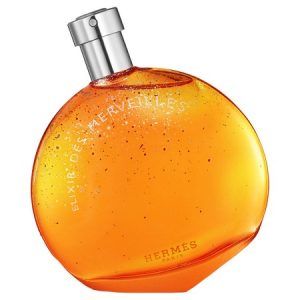
Elixir des Merveilles uses the distinctive pebble-shaped Merveilles bottle — rounded body, tumbler base, deliberately unstable — in an orange colourway that matches the fragrance’s warmth. The body of the glass is dusted with a constellation of silver stars, and the cap is a silver spray closure. Like the other Merveilles bottles, Elixir does not stand straight on a dresser; it leans slightly, as a kind of editorial wink at the fragrance’s own playful identity.
Visually, Elixir is the warmest of the Merveilles bottles. Next to the blue of Bleue or the starred-dark of L’Ombre, Elixir reads as fire or late afternoon — the sun setting through amber glass.
Where it sits in the Merveilles family
Reading Elixir des Merveilles against the rest of the family:
- Eau des Merveilles (2004, Schwieger and Feisthauer) — the original; woody-amber, citrus-sparkling, ambergris-centred.
- Elixir des Merveilles (2006, Ellena) — reviewed here; gourmand-amber, warm, dessert-adjacent.
- L’Ambre des Merveilles (2012) — deeper amber reading; closest to the original’s aesthetic.
- Eau des Merveilles Bleue — maritime-cool, a summer reading.
- L’Ombre des Merveilles — incense-chiaroscuro, evening-oriented.
Within the family, Elixir is the most extroverted and the most pleasure-focused. Where the original is atmospheric, Bleue is coastal, and L’Ombre is contemplative, Elixir is openly enjoyable. It is the Merveilles fragrance for the kind of wearer who wants warmth above everything else, and it sits comfortably alongside winter fragrances in the wider Hermès catalogue.
Read more broadly, Elixir is one of the few clearly gourmand fragrances in the Hermès women’s line, which is historically more interested in transparent florals and woody-ambers than in sweet compositions. For wearers moving through the Ellena Hermès catalogue, it is often a surprise — the dessert in a set of meals largely built around other courses.
Closing
Elixir des Merveilles is Jean-Claude Ellena’s warmest fragrance for Hermès and one of his cleaner arguments for how gourmand can be done without losing structure. Eighteen years after its release, it still reads as one of the finer winter compositions in the mainstream women’s market — a candied-orange and vanilla-biscuit opening that earns its warmth through a serious woody-amber-incense base. It is the Merveilles fragrance for cold nights and warm rooms, and it continues to win over wearers who would otherwise avoid anything in the gourmand category.