 DealNest
 How a slim silk scarf, introduced by Hermès in the early 2000s as a youthful descendant of the Carré, became the name of one of Christine Nagel’s most commercially successful fragrance launches.
The Twilly d’Hermès fragrance, released in 2017, was Christine Nagel’s first major women’s signature for the house — a ginger-tuberose-sandalwood composition reviewed in full in our main piece on Twilly d’Hermès. This companion article focuses on the other Twilly — the silk scarf for which the fragrance is named — and on how a piece of Hermès textile craft became the organising metaphor for a perfume. The story is a small case study in how the house thinks across its different disciplines, and how a single idea can move between categories while retaining its identity.
The Carré, the Hermès silk tradition
The Hermès silk scarf tradition begins in 1937, when Robert Dumas — then a director of the house — introduced the first Carré. The inaugural design, titled Jeu des Omnibus et Dames Blanches, was a 90cm-by-90cm square of printed silk twill, and it was not an immediate commercial success. The Carré took time to establish itself. By the 1950s it had become a recognisable Hermès product; by the 1960s it was an icon; by the 1970s it was one of the most widely recognised luxury goods in the world, worn by public figures and copied (badly) across the mass market.
A Carré in its original form takes roughly 500 hours of engraving work to produce. The silk is printed from hand-engraved screens, one screen per colour, and the house maintains an internal colour library that has been variously estimated at around 75,000 shades. The famous Brides de Gala design, introduced in 1957 by Hugo Grygkar, remains the best-selling Carré in the house’s history and has been re-issued in countless colourways.
The Carré established a particular kind of conversation between Hermès and its customers. A scarf is not a garment in the conventional sense; it is an accessory that has to be interpreted by its wearer — tied, folded, arranged, re-worn across different contexts. The Hermès Carré invited that interpretation from the beginning, and the house has continued to trust its wearers to do the interpretation ever since.
The Twilly arrives
In the early 2000s, Hermès introduced the Twilly — a slim descendant of the Carré, narrower than the original and designed for a younger customer. The Twilly scarf measures 86cm long by 5cm wide, roughly one-ninth the surface area of a standard Carré, and its proportions reflect the different roles the house wanted it to play.
Where the Carré had developed a sense of formality over its decades of production — a piece of silk that signalled a certain kind of adult elegance — the Twilly was designed to be played with. Hermès’s own marketing around the Twilly scarf used language that would later find its way into the 2017 perfume brief: “Do not respect the Carré; dare to crumple it, push it aside.” “Play, invent, try, let your imagination run wild.”
Those imperatives established the Twilly as a scarf for experimentation. It could be tied in the hair, worn around the wrist, knotted at the neck, used as a belt, or attached to a handbag handle — the latter being perhaps the most common contemporary use, with the Twilly wrapped around the handle of a Kelly or Birkin bag as a small piece of visible Hermès craft that the whole outfit could rotate around.
The Twilly scarf also carried the production standards of the Carré at its smaller scale — the same silk, the same engraved-screen printing, the same colour discipline. It was not a simplified product; it was a concentrated one.
From scarf to perfume: the crossover
When Hermès commissioned Christine Nagel to compose a new women’s fragrance in the mid-2010s, the house wanted a composition that would speak to a younger customer than the Ellena-era Jour d’Hermès had addressed. The women’s line needed an extrovert entry — a fragrance that was confident, youthful, slightly irreverent, and unmistakably contemporary. The house’s existing women’s fragrances were, by 2016, mostly in a more restrained register than the younger customer wanted.
The choice to name the fragrance Twilly, and to anchor it in the Twilly scarf’s identity, did several editorial jobs at once. It gave the fragrance an immediate design reference that customers already understood. It signalled that the fragrance was for the same wearer who wore a Twilly scarf — someone comfortable with colour, with experimentation, with a slightly playful version of Hermès elegance. And it let Nagel compose the fragrance with a clear brief: this had to sound the way a Twilly scarf looked.
The editorial framing that Nagel used around the launch echoed, almost word-for-word, the language Hermès had used around the Twilly scarf for more than a decade. “Free, daring and irreverent, they play against the wind,” Nagel said of the women she had in mind while composing the fragrance. “Imposing their own rhythm, inventing an unprecedented rhythm.” The phrasing was not coincidental — Nagel was translating the scarf’s established identity into scent.
Three ingredients, one attitude
The fragrance itself — reviewed in our main Twilly d’Hermès piece — is built around three materials: ginger, tuberose and sandalwood. In brief, each one does specific work:
- Ginger opens the fragrance with a spicy, peppery, slightly soapy edge. It is the spark.
- Tuberose occupies the heart with a creamy, honeyed, slightly heady white-flower character. It is the body.
- Sandalwood carries the base with a warm, smoky, resinous foundation. It is the stay.
In Nagel’s own framing, these three ingredients were “diverted to become bite that burns, attraction that disturbs, carnal that is revealed” — a description that translates the three-ingredient structure into the attitude the scarf’s name was already carrying.
The bottle as third Twilly
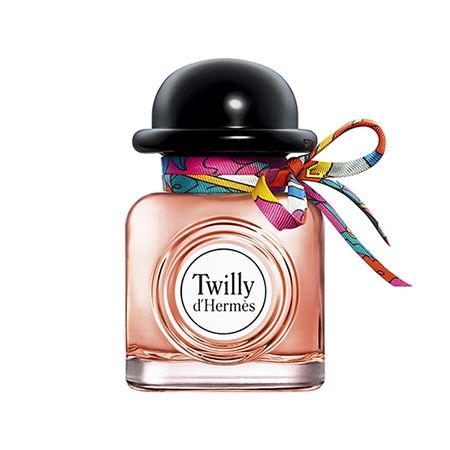
The Twilly fragrance bottle — a slender lantern-shaped glass column in the shared Hermès cologne-bottle silhouette — extends the scarf-to-perfume translation one step further. The body of the bottle holds the fragrance’s warm orange juice, the cap is an opaque black, and, most importantly, a small hand-tied silk Twilly scarf is fixed at the neck of each bottle. Each of those small scarves is a unique piece, printed and tied individually, so that no two Twilly fragrance bottles are identical.
That detail is the most concrete expression of the crossover. The bottle is not decorated with a Twilly-style pattern; it actually carries a small version of the Twilly scarf as part of its physical construction. A wearer who buys the fragrance receives both an olfactory and a textile object, and the Twilly scarf’s presence on the bottle collar is a small, permanent reminder that the fragrance and the scarf share a single design logic.
For wearers who already own a larger Twilly scarf, the bottle creates a direct visual conversation with the rest of the collection. For wearers new to the Twilly idea, the bottle introduces the scarf through the fragrance — and the house has reported strong crossover effects, with Twilly-scarf customers buying the fragrance and fragrance customers discovering the scarf.
The Twilly as cross-discipline Hermès
Hermès has, for most of its history, treated its different categories — saddlery, silk, leather, ready-to-wear, perfumery, jewellery, porcelain — as parts of a single continuous practice rather than as separate business lines. A single design idea can move between them, translated into the materials and craftsmanship each category demands. The horse-and-carriage motifs of the early Hermès identity appear across every category. The Carré scarf designs have been adapted into wallpapers, ties, and home textiles. The stirrup shape appears in jewellery, scarves, and — as the bottle of Christine Nagel’s Galop d’Hermès — in fragrance presentation.
The Twilly fragrance is one of the cleaner examples of that cross-discipline translation. A textile product from the scarf line has been rendered into a fragrance composition that carries its attitude; a fragrance bottle has been dressed with a physical version of the textile product; and the marketing of each reinforces the other. It is a small case study in how Hermès uses its own catalogue as the raw material for new products.
Flankers and line extensions
Since the 2017 launch, Hermès has extended the Twilly fragrance line in several directions. The most significant addition is Twilly d’Hermès Eau Poivrée, Nagel’s 2021 pink pepper-rose-patchouli flanker, which keeps the Twilly identity while shifting the register into a more chypre-inflected adult mode. The Twilly scarf line has continued to grow in parallel, with new patterns released regularly.
For wearers building out a full Twilly wardrobe — fragrance, scarf, and related accessories — the line now offers enough variation to occupy a whole category of the house’s women’s catalogue rather than sitting as a single launch. That growth is, again, in keeping with the Hermès pattern: once a product idea has been established and welcomed, the house extends it patiently rather than abandoning it for the next trend.
Closing
The Twilly d’Hermès fragrance is the perfume that most openly argues for the Hermès cross-discipline practice. A scarf became a fragrance name; the fragrance became a bottle with a scarf; the bottle became a reminder of the scarf. Christine Nagel’s composition did the olfactory work, but the idea Hermès was building around had already been cultivated across years of silk craft. For wearers who love the Twilly scarf, the fragrance is a natural extension. For wearers new to the Hermès world, the two products together make the case for how the house thinks about design — one idea, many materials, continuous conversation.