 DealNest
 “Free, daring and irreverent, they play against the wind, imposing their own rhythm.” — Christine Nagel
Twilly d’Hermès, released in 2017, was Christine Nagel’s first major women’s signature for the house after she succeeded Jean-Claude Ellena as in-house perfumer. It is a fragrance composed around just three main ingredients — ginger, tuberose and sandalwood — and presented in a bottle tied, by hand, with one of the silk Twilly scarves from which the fragrance takes its name. It is a noticeably younger, louder and more extroverted proposition than the Ellena women’s compositions that preceded it, and it represented a deliberate generational shift in how Hermès addressed its women’s customer. This is a long review.
A new voice for the women’s line
By 2017, the Hermès women’s perfume line had a clear Ellena signature: quiet, luminous, floral, restrained. Jour d’Hermès (2013) and Jour d’Hermès Absolu (2014) were the newest entries in that register, and they set a specific tone — a fragrance for a wearer who preferred tenderness to drama. Twilly, composed by Christine Nagel, moved in a different direction. It was designed for a younger wearer, one who, in Nagel’s own words, “plays against the wind” and “imposes her own rhythm.” Where Jour whispered, Twilly announces itself and sticks around.
This is not a criticism. The Hermès women’s line needed a new register for a new generation, and Twilly gave the house its first mainstream commercial hit in the women’s space in some time. It has since generated flankers and remains one of Nagel’s most recognisable compositions for Hermès.
The three-ingredient idea
Nagel built Twilly around three ingredients: ginger, tuberose and sandalwood. In perfumery terms, this is a compact brief — most commercial women’s fragrances list double or triple that number of notes — and the restraint is what allows Twilly to read so clearly on first spray. Each of the three ingredients carries its own weight.
The ginger at the top is the unusual component. Obtained from the roots of the plant by distillation, the ginger in Twilly is spicy, peppery and faintly soapy — a bright, slightly chilled opening that gives the fragrance its first-impression character. It is not the warm baked-ginger of a gourmand; it is the raw, sliced-root ginger of a Southeast Asian kitchen.
Tuberose, in the heart, does the heavy lifting. Tuberose is one of perfumery’s classic “white flower” materials, simultaneously creamy, honeyed, slightly indolic and faintly animal. It is the note that makes white-flower fragrances polarising. In Twilly, Nagel uses tuberose in a modern, trimmed-down way — heady enough to be recognisable, but never cloying — and pairs it immediately with the cooling ginger to keep the composition balanced.
Sandalwood anchors the base. Creamy, smoky and slightly sweet, it is a traditional oriental material, and it gives Twilly a soft, close-to-skin warmth that lingers several hours after the top and heart have receded. Nagel’s sandalwood is clean rather than dense — closer to the Australian-style sandalwood used in much of contemporary perfumery than to the thick, resinous Mysore sandalwood of classical compositions.
Olfactory profile
- Family: Spicy — Floral
- Top: Ginger
- Heart: Tuberose
- Base: Sandalwood
- Perfumer: Christine Nagel
- Year: 2017
- For: Women (wears youthful)
How it wears
Twilly is an unusually performative fragrance for Hermès. It projects more than Jour, more than Terre d’Hermès, and in its opening it can feel almost loud compared to the usual house register.
In the first twenty to thirty minutes, ginger and tuberose arrive together with the ginger sharper and the tuberose already swelling beneath it. This is the most extroverted phase of the fragrance — the one that reads most clearly in the first few metres around the wearer. It is also the phase that some wearers find most challenging, because the ginger can read peppery and the tuberose can read heady depending on skin chemistry. Sampling is strongly recommended.
Through the middle hours, the balance shifts. Ginger loses much of its edge within the first hour; tuberose fills the composition and takes the lead; sandalwood begins to make itself felt underneath. This is the phase when Twilly settles into its most recognisable signature — a warm, creamy, slightly-spiced tuberose, confidently sized, unambiguously feminine.
The drydown, over several hours, is the sandalwood foundation with a quiet echo of tuberose still audible. Twilly lasts longer on skin than most of the Ellena Hermès women’s fragrances; a generous application will still be detectable on fabric the next day.
Who it’s for
Twilly was explicitly designed for a younger wearer, and that design shows. The fragrance rewards wearers who are comfortable with presence — who wear fragrances that people notice — and who like the combination of spice and white flower. It is not a quiet fragrance and it does not try to be one.
It performs best in cooler temperatures. In high heat, the tuberose can swell uncomfortably and the ginger can sharpen; in spring, autumn and cool summer evenings, the composition reads at its most elegant. It is a fragrance that suits evenings better than mornings, and social occasions better than offices — though plenty of wearers have made Twilly work as a daily fragrance by keeping the application modest.
If you tend to reach for white-flower fragrances in general, Twilly is one of the better contemporary mainstream entries in that register. If you found classic tuberose compositions too heady, the ginger in Twilly may be the move that lets you wear this family. If you have tried tuberose before and dismissed it, Twilly is unlikely to convert you.
The bottle: lantern and scarf
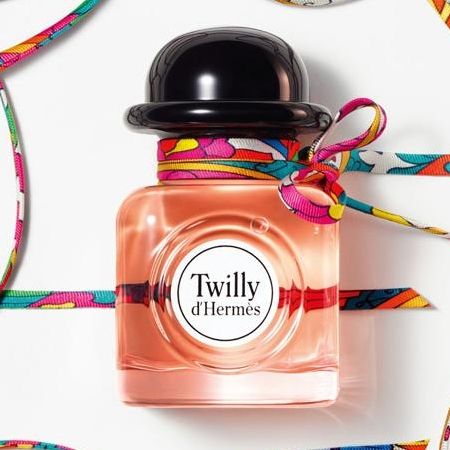
The Twilly bottle is one of the more charming presentations in the current Hermès perfume line. It takes the shape of a slender glass column — a reinterpretation of the lantern used on horse-drawn carriages of the nineteenth century — and it makes the fragrance’s warm orange colour visible through the transparent glass. The cap is opaque and black. The detail that finishes the bottle is the hand-tied silk Twilly scarf at the neck, each one a unique piece.
For wearers who own Hermès silks, the bottle is a small wink at the Twilly scarf itself — the slim, 86cm-by-5cm silk ribbon that Hermès introduced in the early 2000s as a descendant of the famous Carré. The scarf can be worn in the hair, around the wrist, tied to a handbag handle or at the neck; the bottle references the product that gave the fragrance its name, and completes the idea of Twilly as the crossover between Hermès couture and Hermès perfumery.
The Hermès scarf history, briefly
The Carré Hermès was introduced in 1937 by Robert Dumas, then director of the Hermès company, and the first design was titled Jeu des Omnibus et Dames Blanches. The scarves were not immediately a success, but they have since become one of the defining products of the house. Brides de Gala, designed in 1957, remains the best-selling Hermès scarf of all time. Producing one Carré involves roughly 500 hours of engraving work, and the house maintains an internal colour library of approximately 75,000 shades to support the printing of its silks.
The Twilly is the slim descendant — narrower than the Carré, introduced in the early 2000s, designed for a younger customer who wanted to wear Hermès silk in less formal ways. Twilly the fragrance is the olfactory extension of the same idea.
Where it sits in the Hermès women’s line
Twilly is the extroverted end of the Hermès women’s spectrum. Reading it alongside the other major women’s compositions in the house:
- Calèche (1961) — aldehyde-floral, classical, formal.
- 24 Faubourg (1995) — warmer, sunnier, floral-oriental.
- Jour d’Hermès (2013) — Ellena’s luminous floral, quiet and dry.
- Jour d’Hermès Absolu (2014) — the fuller, warmer reading of Jour.
- Twilly d’Hermès (2017) — Nagel’s bold ginger-tuberose-sandalwood, reviewed here.
- Twilly Eau Poivrée — the later flanker, which takes the Twilly idea in a spicier, rose-and-pepper direction.
Twilly sits at the loud, young end of this line, and that is exactly where Hermès wanted a new entry.
Closing
Twilly d’Hermès was the fragrance Hermès needed in 2017: a contemporary, confident, unmistakably feminine composition that expanded the women’s line without abandoning the house’s standards. Christine Nagel’s first major signature for the maison still reads, almost a decade later, as one of the cleaner arguments for the three-ingredient approach to commercial perfumery — proof that a fragrance does not need a crowded pyramid to make a statement. It is bold where Jour is quiet, modern where Calèche is classical, and recognisably Hermès where, in lesser hands, a fragrance like it could have read generic.