Bel Ami, Refinement According to Hermès: Maupassant, Seduction and the Art of Masculine Elegance
 DealNest
 A companion reading of the Hermès Bel Ami fragrance — its literary source, its philosophy of refinement, and the craft traditions that give it weight.
The Hermès Bel Ami fragrance is one of the house’s defining masculine compositions, and our full fragrance review treats the olfactory pyramid and wearing notes in detail. This companion piece steps outside that technical frame to consider the fragrance as a cultural object — what it borrows from Guy de Maupassant’s 1885 novel, how Hermès has translated that borrowing into a particular idea of masculine elegance, and why the fragrance has, more than any other recent Hermès men’s launch, continued to find new wearers in the decades since Jean-Louis Sieuzac composed it in 1986.
The Maupassant novel and the archetype it created
Guy de Maupassant’s Bel-Ami, serialised in Gil Blas from April 1885 and published in book form the same year, follows the social rise of Georges Duroy, a provincial former cavalry officer with no money, few scruples and considerable charm, through the newsrooms and salons of Third Republic Paris. The nickname “Bel-Ami” — handsome friend — is given to Duroy by the young daughter of one of his conquests, and it sticks to him for exactly the reason the reader suspects: Duroy is beautiful, present, agreeable, and dangerously willing to use those qualities.
Maupassant wrote Bel-Ami with the detachment of a journalist who has spent too long watching the machinery of Parisian politics and society operate up close. The novel is a character study, but it is also a social document — a portrait of a post-Commune Paris in which ambitious young provincials could, with sufficient charm and few enough moral constraints, ascend remarkably quickly through its overlapping networks of journalism, speculation and state power. Duroy’s career mirrors the age. He fails upwards because the age allows it.
For Hermès in 1986, naming a men’s fragrance after this novel was a considered gesture. Bel-Ami is simultaneously attractive and compromised — the reader admires his style and mistrusts his motives. That ambiguity is the fragrance’s editorial DNA. The Hermès Bel Ami is not a straightforwardly heroic masculine perfume; it carries a small shadow. It suggests a wearer who understands charm as a tool, and who wears it knowingly. The house has never been shy about the fragrance’s literary source, and the source has never stopped doing editorial work on the product’s behalf.
Refinement as a house principle
The word “refinement” is used often in the marketing language around Hermès, and it carries more freight than it sometimes appears to. Refinement, in the house’s usage, is not decoration. It is the opposite. It is the practice of removing everything that does not serve the object’s function or identity, and letting the remaining elements speak without embellishment. The Hermès refinement is legible across every category the company works in — saddlery, leather goods, silk, perfumery — and it operates according to the same grammar in each.
In perfumery, that grammar means: a single clear idea; a small number of materials chosen for their quality rather than their novelty; a structure in which the base carries real weight rather than relying on synthetic fresheners to do the wearing-time work; a bottle that signals the house without shouting. Bel Ami is an archetypal Hermès refinement. Its pyramid is not long — a manageable citrus and spicy top, a dense carnation-and-patchouli heart, a castoreum-oakmoss-leather base — but each element is given room and the composition earns its density through structure, not through accumulation.
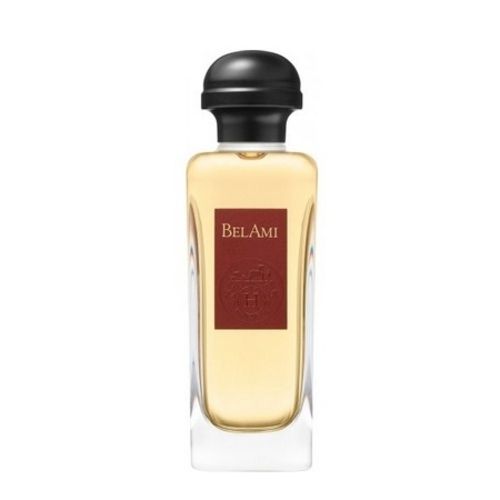
The fragrance’s philosophy is visible in the bottle as well. Bel Ami’s flask is a rectangular glass column with a black cap — understated by the standards of the fashion houses, and absolutely dignified in isolation. It is the fragrance world’s version of a well-cut tailored jacket. Nothing about it is trying too hard.
Leather as the house’s first material
Hermès was founded in 1837 in Paris as a harness maker. Thierry Hermès’s original business served the city’s coach trade, producing the leather harnesses that connected horses to carriages. Charles-Émile Hermès expanded the business into saddlery in 1880, and the saddlery workshops at the house’s flagship address — 24 Faubourg Saint-Honoré — remain in operation today, producing made-to-order saddles with techniques that have changed relatively little since the nineteenth century.
Every other thing Hermès does — the bags, the scarves, the fragrances, the porcelain, the jewellery — is in some degree downstream of the harness-maker’s shop. Leather is the house’s first material, and the craftsmanship traditions that grew up around leather work have shaped the company’s standards for quality across every product category.
In Bel Ami, leather is not decorative. It is the fragrance’s spine. Castoreum, styrax, patchouli and labdanum together create a leather accord that evokes the smell of worked hide — a library of leather-bound books, a well-conditioned riding saddle, a handmade wallet opened in a quiet room. The accord does not try to reproduce the exact smell of any real leather; it produces the idea of leather, rendered in the vocabulary of French perfumery. That is, itself, a refinement.
The dandy tradition and its quiet persistence
Duroy is not exactly a dandy — he lacks the aesthete’s self-consciousness and the dandy’s distance from the social rewards of charm — but the fragrance Hermès built around his name draws from the same stream of nineteenth-century thinking about masculine elegance. The dandy tradition, as articulated by Baudelaire, Barbey d’Aurevilly and Wilde, proposed that masculine elegance was not a matter of expense or ornament but of presence — of the willingness to be a certain kind of person with complete attention to detail.
Bel Ami is a fragrance for that tradition. It is not a fragrance for the loud, the boastful or the newly rich. It is a fragrance for the man who understands that his clothing, his manner, his choice of fragrance and the quality of his silence are all components of a single composed impression, and who takes that impression seriously without appearing to take himself too seriously. The scent rewards exactly that kind of attention. It does not perform for a crowd; it rewards the person across the table.
The fragrance as cultural document
Almost four decades after its release, Bel Ami reads as a document of a particular moment in both French perfumery and in mainstream culture’s relationship to male elegance. The 1980s were the last real decade in which a new mainstream men’s fragrance could be built confidently around castoreum, patchouli and oakmoss at full strength; later regulatory restrictions on oakmoss use changed the category’s vocabulary permanently. The 1980s were also, arguably, the last decade in which a major luxury house could market a men’s fragrance with the kind of literary-cultural framing Hermès used for Bel Ami and expect the framing to land.
That double specificity is what gives the fragrance its continuing interest. It is simultaneously a product of its era — the density of the composition, the seriousness of the literary reference, the assumption of a wearer who has read Maupassant or is willing to — and a fragrance that has aged well enough to feel contemporary on the right wearer. A cursive watch, a well-kept leather jacket, a single malt that was distilled before the buyer was born — Bel Ami fits alongside those objects without awkwardness.
Sibling fragrances and continuations
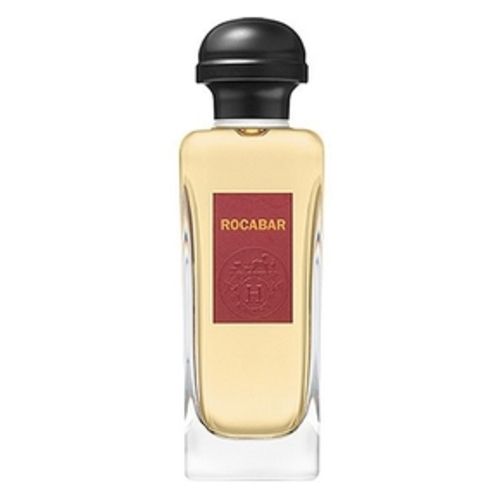
Hermès’s continued work on the leather register across four decades is best read through the fragrances Bel Ami sits alongside. The house’s earlier leather tradition runs through Eau d’Hermès (1951, Roudnitska), which first articulated the citrus-spice-over-leather register that Bel Ami extended in 1986. The later Bel Ami Vétiver (composed by Jean-Claude Ellena) is Ellena’s rewriting of Sieuzac’s composition in a greener, lighter key, swapping patchouli for vetiver and simplifying the architecture. Rocabar (1998, Gilles Romey) expanded the saddlery idea in a different direction, centring on cypress and the woven horse blanket rather than on leather itself.
And in 2016, Galop d’Hermès, composed by Christine Nagel, offered the house’s first twenty-first-century reading of the leather register — a brighter, rose-inflected leather in a stirrup-shaped refillable bottle, housed in a visual language that explicitly returned to the house’s equestrian founding. Together the leather-Hermès line tells a story: from Roudnitska’s 1951 citrus-leather to Sieuzac’s 1986 castoreum-leather to Ellena’s later, more transparent readings to Nagel’s contemporary brighter leather. Bel Ami is the thickest chapter in the story, and in many ways the pivotal one.
A fragrance with a shadow
To wear Bel Ami is to put on, quietly, a fragrance named for a character who is neither entirely likeable nor entirely dislikeable — a character whose charm is real and whose motivations are mixed. That ambiguity is part of what has kept the fragrance alive. A perfume too straightforwardly heroic wears as costume; Bel Ami wears as character. The wearer, in effect, accepts the fragrance’s small shadow as part of the package — the literary reference that the bottle carries, the knowing edge to the leather, the suggestion of a more complicated kind of masculinity than the category usually permits.
For a wearer coming to Bel Ami now, almost four decades after its release and nearly a century and a half after Maupassant gave the nickname to his ambitious journalist, the fragrance is an unusually coherent piece of luxury design. Novel, composition, bottle and house all work in concert. That coherence is rare in the contemporary market, and it is not something Hermès has tried to reproduce in the years since. Bel Ami was a particular moment of alignment, and the moment produced a fragrance that has, so far, refused to date.
Closing
Bel Ami is the Hermès masculine fragrance that most openly carries a point of view about masculine elegance. It borrows from a novel, it refines a material, it trusts its wearer to understand the reference. For anyone moving through the Hermès men’s catalogue, Bel Ami is the composition that teaches you the grammar of the house’s masculine refinement most clearly — and the one that continues, quietly, to make the case for why taking a men’s fragrance seriously is a worthwhile thing to do.