Hermès Eau de Néroli Doré Review: Jean-Claude Ellena’s Mediterranean Orange Blossom Cologne
 DealNest
 “When I started out in the perfume profession, I learned to distill raw materials, including orange blossom. My whole being was then scented with orange blossom.” — Jean-Claude Ellena
Eau de Néroli Doré — known in English-language markets as Golden Neroli Water — is Jean-Claude Ellena’s 2016 addition to the Hermès cologne collection, and one of his most personal compositions for the house. It is a fragrance that takes the Mediterranean orange blossom of his early training days as a perfumer in Grasse and builds a cologne around it, with an unusually generous dose of neroli at the centre and saffron threaded through as a Mediterranean counter-voice. This is a long review of what the fragrance is, why Ellena chose neroli as its centre, and where it sits in the Hermès cologne line.
Ellena’s fifth cologne
By 2016, Jean-Claude Ellena had been Hermès’s in-house perfumer for twelve years, and his contributions to the house’s cologne collection — which began with Françoise Caron’s Eau d’Orange Verte (1979) and grew steadily through the 2000s — had become one of the quiet through-lines of his Hermès tenure. He had composed Eau de Pamplemousse Rose, Eau de Gentiane Blanche, Eau de Mandarine Ambrée and Eau de Narcisse Bleu, each one a single-idea cologne built around one or two central materials treated with unusual care. Eau de Néroli Doré was his fifth entry in the collection, and — in the timing of its release — one of his final compositions for the house before Christine Nagel succeeded him as in-house perfumer.
It is not, however, a valedictory fragrance. Eau de Néroli Doré is one of the sunniest and most openly optimistic compositions in the whole Hermès cologne line — a fragrance that, in Ellena’s own framing, reads as a return to the scents of his own beginnings rather than a summation of his career.
Ellena and orange blossom
Ellena was born in Grasse, the old perfumery city in the south of France, to a father who was himself a perfumer. His training in the industry started early — he has spoken often about learning the technical craft of distillation in his teens — and orange blossom was one of the first raw materials he worked with. In his own description, the period left him “scented with orange blossom” as he worked in proximity to the stills. The ingredient has carried personal resonance for him ever since.
That biographical weight matters for Eau de Néroli Doré because the fragrance is unusually unguarded about its inspiration. Where many of Ellena’s Hermès compositions are built around abstract ideas — the landscape of Terre d’Hermès, the dawn-light of Jour d’Hermès — Eau de Néroli Doré is built around a memory. The orange blossom at its centre is not a decorative flourish; it is, in the perfumer’s own words, a return to “what he calls ‘his’ Mediterranean.”
The composition: neroli at full volume
Neroli is the essential oil obtained by the steam distillation of orange blossom flowers — the bitter orange tree, Citrus aurantium — and it has a distinctive, clean, zesty-floral quality that sits somewhere between citrus and floral without quite belonging to either. It should not be confused with orange blossom absolute, which is extracted rather than distilled and which has a warmer, heavier, slightly indolic character. Neroli is the brighter, greener, more transparent half of the orange-blossom family.
Traditionally, neroli has been used in perfumery in relatively modest doses — a brightening top-note that lifts citrus structures or supports larger floral accords. Ellena’s move with Eau de Néroli Doré was to put neroli at the centre of the composition at an unusually generous concentration. The fragrance is unmistakably neroli-forward; you smell it as neroli before you smell it as anything else. That decision gives Eau de Néroli Doré its singular character within the Hermès cologne line.
The supporting cast is deliberate and small. A light Mediterranean citrus framework surrounds the neroli at the opening. Saffron — used sparingly but audibly — threads a warm, slightly leathery, faintly exotic line through the heart, and is the element that pushes the fragrance away from pure orange-blossom and toward something more specifically Mediterranean-inflected. The drydown is a quiet musky-floral warmth that lets the neroli linger on skin longer than most cologne top notes would allow.
Olfactory profile
- Family: Citrus Cologne — Floral facet
- Centre: Neroli (orange blossom distillate)
- Supporting notes: Light Mediterranean citrus, Saffron
- Perfumer: Jean-Claude Ellena
- Year: 2016
- For: Unisex
- Part of: Hermès cologne collection
How it wears
Eau de Néroli Doré opens bright and unambiguous. Neroli arrives first, with a clean citrus edge, and within a minute or two the full orange-blossom quality has bloomed on skin. A wearer familiar with neroli will recognise the ingredient immediately; a wearer new to neroli often reaches for comparisons with orange peel, white flowers, or a sunlit citrus garden — all of them partially right.
Through the first thirty minutes, the composition is at its most characteristically cologne-like: sunny, light, cool on the skin. Unlike many cologne openings, however, it does not feel bathroom-fresh or generic. The neroli is specific and high-quality enough to carry the fragrance on its own.
The heart brings in the saffron, and this is where Eau de Néroli Doré does its most interesting work. Saffron in perfumery can trend leathery or animalic; Ellena uses it in a light hand, as a warm Mediterranean spice accent that softens the neroli’s brightness and adds a faint, almost honeyed depth. The pairing is unusual for a cologne and gives the fragrance its recognisable middle-phase character.
The drydown is, by cologne standards, generous. A musky warmth carries residual neroli on skin for several hours, and the fragrance stays detectable on fabric for longer still. Like the other Ellena colognes, Eau de Néroli Doré is engineered to outlast the category’s usual lifespan.
Who it’s for
Eau de Néroli Doré suits wearers who already like neroli or orange blossom, and who want a cologne that foregrounds the ingredient rather than using it as a supporting note. It is one of the more overtly floral entries in the cologne line, and it reads slightly warmer than Eau d’Orange Verte — less green, less minty, more Mediterranean-warm-stone in feeling.
It performs best in spring, summer and early autumn, and in daytime settings. In winter the fragrance can feel a little thin; in high heat it blooms beautifully. It is genuinely unisex in the way most of the Hermès colognes are — nothing about the composition registers as gendered in either direction.
For wearers who have not yet explored the Hermès colognes, Eau de Néroli Doré is an easy and rewarding second or third purchase. It is more specific than Eau d’Orange Verte and therefore less universal, but if the neroli idea appeals, the fragrance delivers on it beautifully.
The bottle
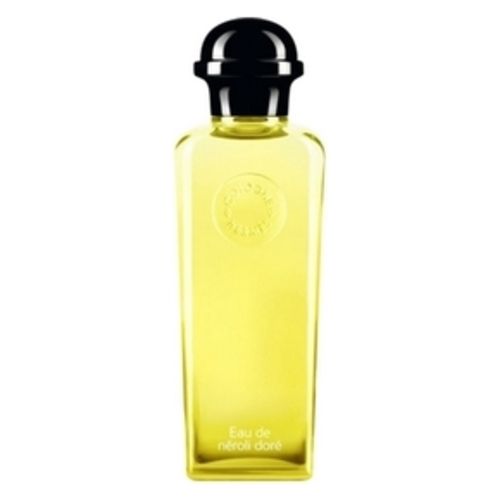
Eau de Néroli Doré uses the same slender lantern-shaped bottle that the whole Hermès cologne line shares, a glass column inspired by the carriage lanterns of the nineteenth century. For this fragrance, the glass is filled with a bright yellow-gold juice — a visual match to the name, Néroli Doré (Golden Neroli). It is one of the more cheerful-looking bottles on the dresser, and the colour alone does some of the fragrance’s editorial work.
The bottle’s cap is the standard black Hermès cologne screw closure, replaceable with a spray attachment. Like the rest of the line, the object is designed to sit cleanly within a collection rather than compete for attention with its siblings.
Where it sits in the Hermès cologne line
Reading Eau de Néroli Doré against the other major colognes in the collection:
- Eau d’Orange Verte (1979, Caron) — the founder; mint-inflected citrus, the widest-angle reading of cologne.
- Eau de Pamplemousse Rose (2009, Ellena) — grapefruit and rhubarb; tart, slightly pink.
- Eau de Gentiane Blanche (2009, Ellena) — gentian root; earthy-bitter green.
- Eau de Mandarine Ambrée (2013, Ellena) — mandarin warmed with amber; sunny-honey.
- Eau de Narcisse Bleu (2013, Ellena) — narcissus; cool, powdery.
- Eau de Néroli Doré (2016, Ellena) — reviewed here; neroli at full volume, saffron accent.
- Eau de Citron Noir (Nagel) — black lemon, smoky.
- Eau de Rhubarbe Écarlate (Nagel) — rhubarb, sharp and red.
Among the Ellena entries, Eau de Néroli Doré is arguably the most emotionally direct. Where the others are constructed around unusual ingredients or technical ideas, Néroli Doré is personal — a fragrance Ellena composed around the material he spent his earliest years in the industry distilling. For wearers interested in understanding Ellena as a perfumer, it is one of the more revealing compositions in the line.
Closing
Eau de Néroli Doré is, at its simplest, one of the most satisfying orange-blossom compositions in mainstream perfumery. It is also something richer: a late Ellena cologne for Hermès that folds the perfumer’s own biography into the fragrance without announcing it. Nearly a decade after its release, it still reads as one of the cleanest and most generous neroli fragrances available — warm, Mediterranean, unguarded, and unmistakably the work of a perfumer who has loved the material for a lifetime.