 DealNest
 “I remembered the smell of ponds, the smell of jasmine, the smell of wet stones, the smell of plum trees, kumquats and giant bamboos. Everything was there — and even, in their pond, carp that took the time to become centenarians.” — Jean-Claude Ellena
Le Jardin de Monsieur Li, released in 2015, is the fifth entry in Hermès’s Jardins collection — Jean-Claude Ellena’s ongoing series of unisex fragrances each built around a specific garden in a specific place. It is the Chinese garden in the series, inspired by memories of a scholar’s garden in China, and it centres on kumquat, jasmine, mint and bamboo. It is one of the cleaner examples of the Jardins idea working at scale, and one of the most coherent unisex fragrances in the contemporary Hermès catalogue. This is a long review.
The Jardins collection
The Jardins d’Hermès line began in 2003 with Un Jardin en Méditerranée, composed by Jean-Claude Ellena for a Mediterranean garden on the coast of Tunisia that he had visited with a friend. The success of that fragrance, and its unusual ability to evoke a specific place without being merely descriptive, led Hermès to commission further Jardins — each one a travel-fragrance built around real memories of specific gardens. By 2015, when Le Jardin de Monsieur Li arrived, the collection included:
- Un Jardin en Méditerranée (2003) — Tunisia, with fig at the centre.
- Un Jardin sur le Nil (2005) — Egypt, with green mango and lotus.
- Un Jardin après la Mousson (2008) — Kerala, with ginger and cardamom.
- Un Jardin sur le Toit (2011) — the roof garden above the Hermès flagship at 24 Faubourg, with apple, rose and pear.
- Le Jardin de Monsieur Li (2015) — a Chinese scholar’s garden, with kumquat, jasmine and bamboo.
Each fragrance in the series is a compact, unisex composition in eau de toilette concentration, built around a few clear ingredients rather than a dense pyramid, and presented in the Hermès lantern bottle. The Jardins line is, among other things, one of the cleanest extended demonstrations of Ellena’s transparent, minimalist aesthetic — a proof that a luxury house can run a successful flagship series without ever raising its voice.
Monsieur Li and the scholar’s garden
The fragrance’s name refers to an unnamed “Mr Li” — a friend of Ellena’s who, in the perfumer’s telling, owned or spent time at a traditional Chinese scholar’s garden. The Chinese scholar’s garden is a specific form: a private, enclosed landscape designed for contemplation, with carefully placed rocks, ponds with carp, bamboo groves, plum trees, pavilions for reading and writing, and small paths that produce the illusion of a larger space. The tradition dates back at least a thousand years in China, and the most famous surviving examples are in Suzhou, where several are preserved as UNESCO world heritage sites.
Ellena’s fragrance is not a literal reconstruction of such a garden; it is an attempt to capture the atmosphere of one. As he described in interviews around the launch, the composition emerged from his memory of ponds and stones, jasmine and plum trees, kumquats and bamboos. The carp in the pond — the “centenarian carp” of the quote — are the most openly poetic element of the inspiration, and they make clear that what Ellena is after is not realism but the slow, contemplative quality of the space.
The composition
The fragrance opens with kumquat — a small, sharp citrus fruit popular in Chinese cuisine — combined with mint. The pairing is unusual for a mainstream fragrance; kumquat in perfumery is rarer than orange or lemon, and the mint gives the opening a cool, slightly vegetal edge that sets Le Jardin de Monsieur Li apart from the other Hermès citrus compositions. The effect is bright, unfamiliar, and immediately signals a fragrance built around a specific place rather than a generic citrus freshener.
The heart is the composition’s most characteristic phase. Jasmine threads through a floral accord that is soft rather than heady — Ellena’s characteristic transparent white-flower treatment — and plum blossom adds a pale, slightly fruity floral dimension that aligns the fragrance with its Chinese inspiration. A hint of Sichuan pepper adds a small spice to the middle, and the effect is neither sweet nor heavy; it is cool, green, and open.
Bamboo leaf is the fragrance’s structural undertone. It provides the composition’s green-vegetal backbone and its sense of freshness that persists through the wear. This is the element that most clearly recalls the garden of the inspiration — bamboo groves being one of the defining plants of the Chinese garden tradition. Musk sits at the base, providing soft skin-warmth and longevity without pulling the composition into any classical register.
Olfactory profile
- Family: Aromatic — Floral Citrus (unisex)
- Top: Kumquat, Mint
- Heart: Jasmine, Plum blossom, Sichuan pepper
- Base: Bamboo leaf, Musk
- Perfumer: Jean-Claude Ellena
- Year: 2015
- Part of: Jardins d’Hermès collection
- For: Unisex
How it wears
Le Jardin de Monsieur Li opens with unusual clarity. Kumquat and mint arrive together in a sharp, cool, slightly herbal-citrus chord that is immediately readable as something other than a conventional citrus fragrance. A wearer familiar with the Jardins line will recognise the series’ aesthetic instantly — transparent, specific, composed around a place — and a wearer new to the line may find the opening unexpectedly cool for a fragrance marketed partly as a summer option.
Through the first hour, the heart develops. Jasmine emerges with Ellena’s characteristic transparent treatment — present, clear, not heady — and the plum blossom adds a quiet floral facet behind it. The Sichuan pepper threads a small spice-line through the middle that keeps the composition from feeling purely green-floral. This phase is the fragrance at its most atmospheric, and it is the phase that best rewards a wearer who takes the time to notice how the composition develops.
Through the middle hours, bamboo and musk take over. The fragrance moves toward a quiet, green-skinny base that sits close to the wearer and projects modestly. Le Jardin de Monsieur Li is not a loud fragrance; it rewards close attention rather than long projection.
The drydown is subtle — a soft musky-green finish that lingers for several hours. Longevity is moderate on skin, as is typical of Hermès eau de toilette concentrations; on fabric, the fragrance holds noticeably longer.
Who it’s for
Le Jardin de Monsieur Li suits wearers who like unisex fragrances with a distinctive sense of place — someone who wants a summer-friendly daily composition that does not read as a generic citrus or a mainstream fresh fragrance. It is particularly well-suited to hot weather, where the kumquat-mint-bamboo chord blooms most beautifully and the cool quality of the composition does its best work.
In cooler seasons the fragrance can feel a little thin, and wearers may find themselves reaching for richer Hermès options like Elixir des Merveilles or Bel Ami. But for anyone wanting a clean, thoughtful summer unisex fragrance from a serious house, Le Jardin de Monsieur Li is one of the better options available.
For wearers exploring the Jardins collection, Le Jardin de Monsieur Li is a strong entry point — the kumquat-and-bamboo idea is particular enough to be memorable, and the fragrance is consistent and well-composed enough to reward repeated wearings. Once the aesthetic clicks, the other Jardins fragrances become easier to appreciate in sequence.
The bottle
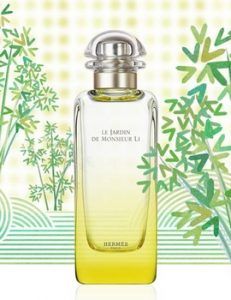
Le Jardin de Monsieur Li is presented in the shared Jardins lantern bottle — the slender glass column inspired by the nineteenth-century carriage lantern, with a black screw cap and an engraved label. For this fragrance, the juice is tinted a soft yellow-gold, which matches the warm kumquat-citrus character of the composition. The bottle sits as part of the Jardins collection visually, and the whole series is designed to be recognisable as a set rather than as individual launches.
For wearers who collect the Jardins, the visual coherence of the bottles is part of the pleasure — a row of lantern bottles in different juice colours makes a distinctive and elegant display.
Where it sits in the Hermès line
Le Jardin de Monsieur Li is one of Ellena’s most characteristic compositions. Read against the broader Ellena Hermès catalogue, it sits alongside the other Jardins as the project that most openly demonstrates his compositional philosophy — a small number of well-chosen ingredients, a specific place as organising principle, and a refusal to overbuild the fragrance beyond what the idea requires.
Compared to his other major Hermès work — Terre d’Hermès, Jour d’Hermès, Voyage d’Hermès — Le Jardin de Monsieur Li is lighter and more specifically place-driven. The fragrance is not trying to define a Hermès register for a category (men’s, women’s, unisex); it is trying to evoke one Chinese garden, and it stays disciplined about that goal.
For wearers of Voyage d’Hermès, Le Jardin de Monsieur Li is a useful parallel — both are unisex Ellena compositions, both are built around a handful of ingredients, both have the sense of motion rather than settlement. The Jardin is the more specific of the two; Voyage is the more general.
Closing
Le Jardin de Monsieur Li is the Chinese chapter in Ellena’s Jardins project — a compact, unisex fragrance built around kumquat, jasmine, mint and bamboo, and designed to evoke the contemplative atmosphere of a scholar’s garden rather than to reproduce any single note. Nearly a decade after its release, it continues to do the work it was designed to do: transport the wearer, quietly and specifically, to a real place. For anyone interested in the Jardins collection, in Ellena’s minimalist compositions, or in a genuinely distinctive unisex summer fragrance, Le Jardin de Monsieur Li remains one of the clearer choices available from the house.